


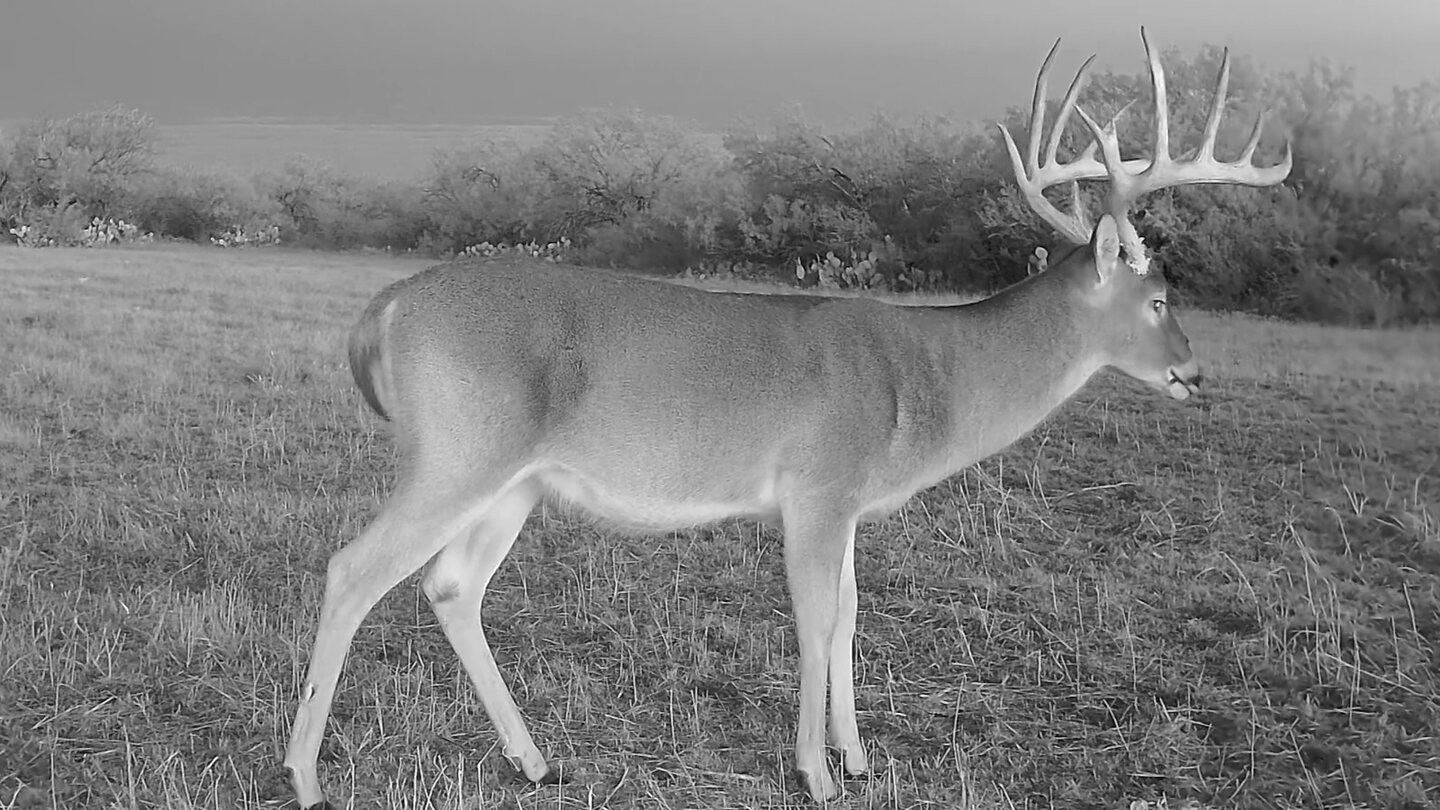
Why We Don’t Judge a South Texas Buck on Antlers Alone
Age, body development, camera history, and management objectives all matter when deciding what a rack really tells us about a South Texas whitetail buck.
A good set of antlers gets your attention. It should. But one of the easiest mistakes in evaluating a South Texas whitetail buck is allowing the rack to answer a question it cannot answer by itself.
How old is this buck? Should we take him this year? Should we give him another season? Where does he fit within the management objectives for the property?
At TheRanch at Camp Ka Hui ‘Ana, those are not simply antler questions. They are questions about the whole deer – and, whenever possible, about what we already know of that individual animal.
That becomes especially important in October. The velvet is gone, antler growth is finished, and the summer photographs we have been collecting start becoming part of real hunting and management decisions. The rack is now easy to see. The harder question is what that rack actually means.
Antlers Tell Us Something About a South Texas Buck – But Not Everything
A rack carries useful information. Main-beam length, tine configuration, mass, symmetry, spread, and year-to-year development can all contribute to evaluating a South Texas whitetail buck. When we have several seasons of game-camera photographs, those characteristics can also help us identify an individual deer and follow his progression.
What antlers cannot do reliably is establish age by themselves. The number of points is especially unreliable as an age indicator. A younger deer may carry an impressive rack, while an older buck may carry fewer points or less antler than someone expects for his age. Nutrition, genetics, health, and individual development all affect the result.
Texas A&M AgriLife guidance on whitetail aging makes the same caution: antler and body size can indicate age class, but physical characteristics can be misleading, and point count does not correspond directly to age.
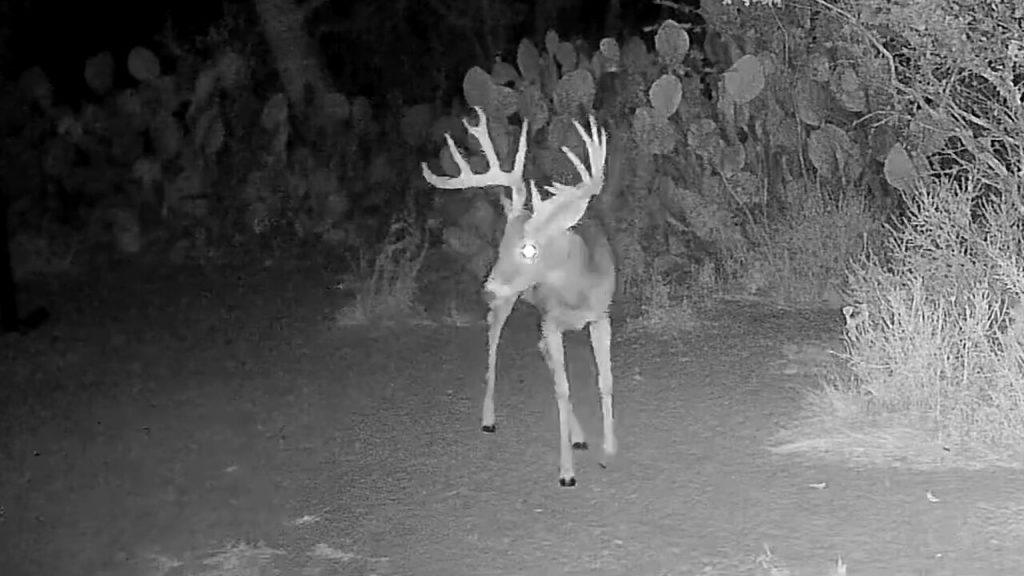
This buck is a good example of why we resist letting antlers make the decision for us. The rack is well developed and immediately catches the eye. But when we look beyond the antlers, the body still suggests a deer that has more physical maturity ahead of him. The photograph is useful precisely because the rack and the body are telling us different parts of the story.
Age Changes the Meaning of a South Texas Whitetail Rack
Age matters because whitetail bucks allocate resources differently as they mature. Young bucks are still investing heavily in skeletal and body growth. As they approach physical maturity, less nutritional energy is required for basic body growth and more can be expressed in antler development.
Research from the Texas Parks and Wildlife Department’s Kerr Wildlife Management Area identifies age, nutrition, and genetics as the three major components affecting body and antler growth. Under normal conditions, antler size commonly continues increasing until a buck reaches roughly five to seven years of age.
That means the same antler measurements can mean different things on different deer. An impressive rack on a 4½-year-old may tell us that a still-developing buck is already showing considerable potential. A similar rack on a 6½-year-old belongs to a deer in a different biological and management category.
Without some understanding of age, comparing those two animals strictly on inches of antler misses much of the useful information.
We Look at the Body Before We Look Back at the Rack
The body of a South Texas whitetail buck can help us estimate an age class in the field, although it cannot establish an exact age. We look at the relationship among the neck, chest, shoulders, belly, back, and legs rather than relying on one isolated trait.
Younger adult bucks generally retain a tighter, more athletic appearance. As a buck matures, the chest and shoulders become heavier, the neck blends more completely into the body during the breeding season, and the belly and back often lose some of the tautness seen in younger deer. The apparent length of the legs also changes as the body becomes deeper and heavier.
But field aging remains an estimate. Camera angle, posture, season, body condition, and nutrition can all change what we think we are seeing. A front-quartering nighttime image and a broadside daylight image of the same deer may create noticeably different impressions.
That is why we do not look at one characteristic and declare an age. We build a case.
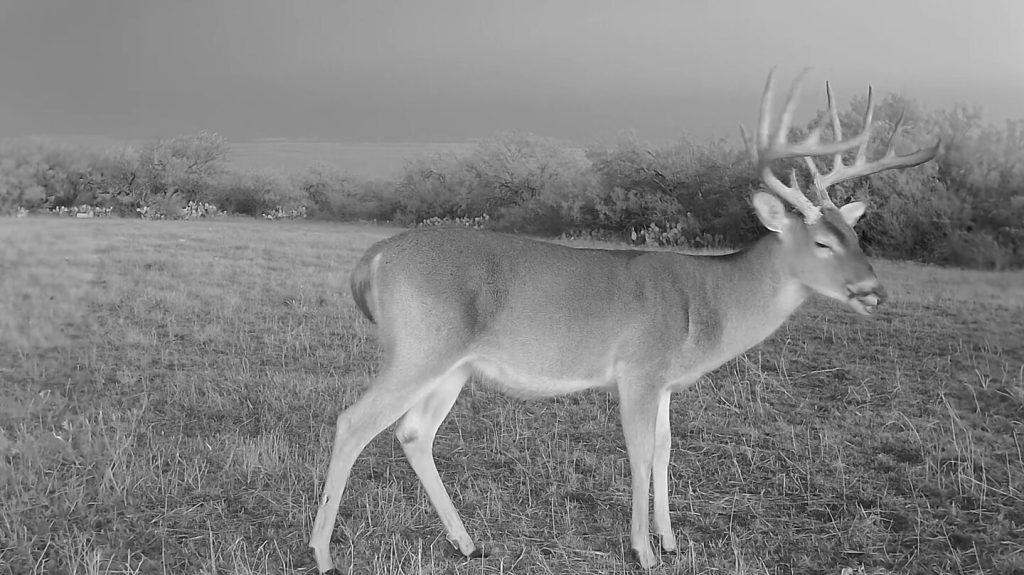
The contrast is useful. With this 6½-year-old South Texas whitetail buck, we are no longer looking only at a rack that appears mature. The body supports the same conclusion: a deeper, heavier deer with the proportions we expect from a fully mature animal. That agreement between body, age history, and antlers gives us much more confidence than antlers alone.
Historical Cameras Can Be More Valuable Than a Single Photograph
One of the strongest advantages we have today is something deer managers of an earlier generation rarely possessed: years of photographs of individual animals.
A single photograph asks us to estimate. A history lets us observe.
If we can confidently identify a South Texas whitetail buck from one year to the next, the question becomes much easier. We may know he was already present three seasons ago. We can compare changes in body development. Over time, we can see whether a particular tine, frame shape, injury, or other identifying characteristic persists. We can also recognize when a deer simply looks different because of camera angle, season, or body condition rather than because he has somehow changed age class overnight.
This is one reason we try to treat game-camera photographs as records rather than simply as a stream of interesting wildlife pictures. The most useful photograph is not always the image of the largest rack. Sometimes it is the photograph that establishes that the deer we are seeing today is the same animal we watched two years earlier. That knowledge can change a hunting decision.
Our August Ranch Journal article, The Final Weeks of Antler Growth in South Texas, looked at the value of late-summer photographs once the year’s rack is nearly complete. October is where that observation starts becoming a decision: not simply what the buck grew, but what the finished rack means when viewed alongside age, body, and history.
Nutrition and Genetics Complicate Simple Comparisons
Even bucks of exactly the same age will not necessarily grow comparable antlers. The Kerr WMA research is useful here because it reinforces a point that is easy to forget when two deer are standing in the same sendero: antler development reflects age, nutrition, and genetics together.
Nutrition is particularly important in South Texas, where rainfall can change native forage quality dramatically from one year to the next. A buck that experiences good nutritional conditions through spring and summer may express more of his genetic potential than the same deer would during a difficult growing year.
We have discussed that relationship in more detail in our Ranch Journal article on spring and summer nutrition for white-tailed deer. The larger point for buck evaluation is simple: a single season should be interpreted cautiously.
The deer has genetics we cannot see directly, an age we may only be estimating, and a nutritional history influenced by environmental conditions we cannot completely control. The rack is the visible result of all of those things.
Sometimes the Best Decision Is Another Year
This is where management becomes more interesting than simply selecting the largest deer that appears.
There are bucks we may choose to pass because we believe they have not yet reached the age at which we want to evaluate them finally. A good rack on a still-developing deer is not automatically a reason to harvest him. In some cases, it is a reason to become even more interested in seeing what another year produces.
That does not mean every younger buck will become an exceptional mature buck, and it does not mean every buck automatically deserves another year. It means age is part of the management objective.
Patience does not guarantee a particular antler score. It gives the deer the opportunity to express more of whatever potential he has. That is a more defensible management principle than assuming today’s rack is the final answer.
And Sometimes the Antlers Are Not the Main Issue
The reverse can also happen. We may encounter an older deer whose rack is not particularly impressive when compared with another mature buck. That does not make the animal unimportant.
His age, physical condition, known history, and place within the management program may make him exactly the deer we should be evaluating. Management decisions work best when the objective is clear before the buck walks into view.
If the only question is, ‘Which deer has the biggest antlers?’ then the rack will always dominate the decision. If the question is, ‘Which animal best fits what we are trying to accomplish with this herd?’ then antlers become one piece of a larger picture.
What We Want to Know Before Deciding on a South Texas Whitetail Buck
Ideally, by the time a buck becomes a real hunting consideration, we want more than one photograph and one opinion.
We want to know whether we have seen the buck before. We want the best estimate we can make of his age class. His body development matters too. Where that history exists, we want to compare his antlers with previous seasons. We want to consider the nutritional conditions under which this year’s rack developed. And most importantly, we want to know what decision actually fits the Ranch’s management objectives.
None of those things makes the decision perfectly objective. Wildlife management rarely gives us that luxury. But the more information we use, the less likely we are to make a decision based on the first thing our eyes naturally notice: the antlers.
The Rack Gets Our Attention. The Deer Makes the Decision.
There is nothing wrong with appreciating a good South Texas whitetail rack. It is one of the reasons these animals are so interesting to follow from spring through fall.
But an antler is the product of the deer, not the definition of him.
By October, we have watched some of these bucks for months. In the best cases, we have watched them for years. That history deserves to count. Age deserves to count. Body development deserves to count. The conditions under which the deer grew deserve to count. And the management objective deserves to count.
Sometimes all of that information points toward taking a buck. Sometimes it points toward letting him walk.
The discipline is making that decision because of what we know about the deer – not simply because of what is growing on his head.
ABOUT THE AUTHOR
related posts

Zulu Still Roams: The Three-Legged Coyote That Refused to Die
April 28, 2026
No Comments